Foods of La Frontera, out this September, is a companion volume to the PBS series by the same name that ran for two seasons in 2021 and 2023. The show, which focused on the communities that live on both sides of the US/Mexico border, was critically acclaimed for its authentic recipes, rich storytelling and beautiful cinematography, winning the 2024 James Beard Award for Outstanding Docuseries.
The book is equally engaging –- a fat, 352-page tome packed with recipes, gorgeous photography and stories that shine a light on the people of the border region, their struggles, and the unique bonds that arise in communities divided by the wall (physical or metaphorical) between Mexico and four American states. What emerges is the knowledge that one of the most powerful connections forged between people of the borderlands is through food and the shared culinary traditions that transcend a geopolitical divide.
Born in Mexico to Jewish parents, raised in a Catholic country and raising her own family in the US, it is not surprising that Jinich has an affinity for the people and food of this region. She doesn’t like the word border, with its political overtones, preferring to call the conjoined lands La Frontera – the frontier, a place where new identities and cuisines are forged out of necessity, opportunity or a mixture of both. Around here, one of her subjects points out: “Todos comemos del mismo plato.” “We all eat from the same plate.”
The book is divided into nine chapters: Tortillas Masa, Frijoles y Arroces (Tortillas. Masa, Beans, and Rice); Salsa, Guacamole y Condimentos (Salsa, Guacamole, and Condiments); Queso, Huevos, Pasta y Pan (Cheese, Eggs, Pasta, and Bread); Sopas (Soups); Mariscos (Seafood); Pollo y Pavo (Chicken and Turkey); Carne de Res, Cerdo y Cordero (Beef, Pork, and Lamb); Verduras (Vegetables) and Postres (Desserts).
As I started cooking, it was immediately clear that the food of this region is far more varied than the hybrid known as “Tex-Mex” north of the border. People from all from all regions of Mexico find their way to the border – and so do all sorts of Americans — bringing with them widely diverse culinary traditions. Where these cultures meet, innovation invariably follows. And as Jinich discovers: “In the third dimension that is La Frontera food can be unapologetically delicious.”
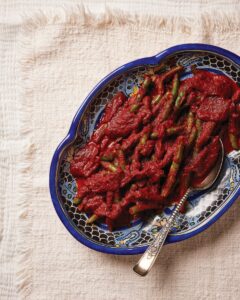
Papitas de Brunch SoCal (Brunch-Style Potatoes) is an easy introduction to the cooking of the borderlands. Influenced by California cafe culture, and ubiquitous in San Diego according to Jinich, it’s a dish of cheesy home fries kicked up with bell peppers, jalapeños and Tabasco sauce. More American than Mexican, it is indeed tasty, if a little bland compared to anything you’d find in Mexico. Ejotes en Salsa de Chile Colorado – (Green Beans in Chile Colorado Sauce), with its brick red sauce of tomatoes and toasted chiles, delivered a lot more punch. The sweetness of ripe tomatoes is essential to balance the chocolatey depth of the toasted chiles. A few months away from sweet summer tomatoes, I used canned tomatoes and suggest you do the same if you’re cooking out of season. My tasters loved the boldly spicy sauce, which could jazz up all sorts of vegetables or proteins.
Ensalada César de Caesar — (Today’s Caesar’s Caesar Salad) is another winner. A classic Caesar prepared tableside in a fine-dining restaurant is a marvel. A few deft moments of whisking and tossing miraculously transforms an assemblage of simple ingredients into a dish of refined sophistication. It’s disheartening how many restaurants manage to mess it up. So, to have the recipe from the original restaurant opened by Cesar Cardini (updated by the Michelin-starred chef whose family took over the restaurant in 2010), which turns out a beautiful salad, is a prize. One small quibble – the egg for the dressing is put into a pot of boiling water for 60 seconds “both for food safety and to slightly thicken the yolk” but the thickening of the yolk is imperceptible and the short immersion in boiling water doesn’t raise the temperature of the egg anywhere near what is needed to neutralize pathogens. Second time around I skipped this step and the difference in the dressing was indiscernible.
For people wary of Scoville heat, Rajas Con Crema y Jitomate (Fire-roasted Poblanos with Tomatoes and Cream) is a good introduction to the world of Mexican chiles. Poblanos have gentle heat but lots of flavour, especially when roasted, peeled and cut into strips called rajas. They have a lot of uses, to punch up flavour of other dishes, as a garnish, or a side dish. Here they combined with tomatoes and cream into a guisado (stew) that can top eggs, serve as a side dish, or as I enjoyed them, a filling for vegetarian tacos.
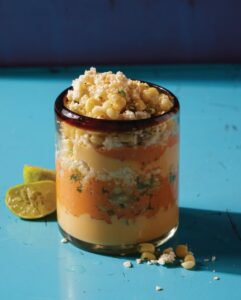
The aptly titled Elotes Locos Regios (Norteño Crazy Corn) is a rich and gooey concoction of corn niblets layered with cheesy sauce and spicy mayo, topped with a squeeze of lime and crumbly cotija cheese. This is a fun appetizer for a party and the leftover chile-spiked mayo is a nifty condiment in its own right.
Tacos Atropellados de Pollo – Run-Over Chicken Tacos came next. Atropellados is translated as “run-over,” hasty,” or “impetuous” – my tasters dubbed the dish road kill chicken. It makes a quick and easy taco filling but take note – one chile (jalapeño or serrano) is cooked whole so you’ll get the full dose of heat from the seeds and veins. Approach with caution.
Frijoles con Veneno (Poison Beans) from Tortillas Masa, Frijoles y Arroces (“the heroes of the plate” in the borderlands) is another dish with an interesting name. It doesn’t mean the beans are toxic – rather there are so many ways of preparing them that it’s a case of “pick your poison” when you choose a recipe. The creamy refried pinto beans seasoned with a sauce made with guajillo and ancho chiles, oregano and orange zest, are easy to make and far superior in flavour to the beans typically served on Tex-Mex combo plates. From the same chapter Arroz Rojo Tejano Mexicano (Tejano Red Rice) is a simple but tasty side of rice cooked with a seasoned tomato sauce.
With the leftover adobo sauce from the poison beans, I made Asados de Puerco (Adobo Pork Stew). Pork shoulder is cooked until falling apart tender then bathed in the sauce. In Nuevo León where it’s from, the stew is served on stacked corn tortillas, which soak up the delicious sauce. I served it over rice, which served a similar purpose.
One look at the photo of Tacos de Hamburguesa con Poblano (Smashburger Tacos with Poblanos) and I had to try this borderland mashup. Essentially an amped-up burger with fixin’s in a tortilla, it is extremely messy to eat but oh so delicious – slurpy, savoury, and spicy!
From the condiments chapter I made Salsa Rojo Cremoso (Creamy Red Salsa) a smooth but fiery sauce combining tomatoes and jalapeño with cream (cream cheese or Mexican crema can be substituted). The jalapeño is simmered whole with the tomatoes, onions and garlic, so again you get all the heat of the veins and seeds. After the first whoa! moment, tasters were spooning this bold and spicy salsa over all sorts of things, from tacos to scrambled eggs.
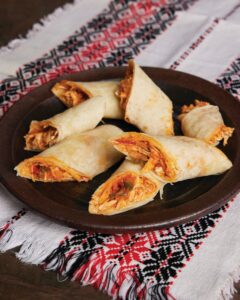
I don’t love North American burritos but the slimmed down versions with simple fillings enjoyed along the border are a different story. Nearly all the leftovers from the dishes I cooked reappeared for lunch rolled up into a slender burrito, with a sprightly salsa on the side. Such an easy way to use up leftovers.
Postres delivered a sweet ending to my exploration of the borderlands. Pastel de Nuez, Dátil, Manzana y Chocolate (Pecan, Date, Apple and Chocolate Snack Cake) gets most of its sweetness from apples, dates and chocolate, without the need for a lot of added sugar. The hand-mixed batter is quick to whip up and requires minimal clean-up. I halved the recipe and baked it in an eight-inch pan instead of a nine-by-thirteen. It needed an extra five minutes in the oven but turned out so well that the moist, nubbly cake was gobbled up immediately.
Cooking my way through this book the technique of toasting/roasting ingredients like chiles – fresh and dried –, garlic, onions and tomatoes was called for again and again. It is a fundamental step in Mexican cooking that builds layers of flavour, bringing depth and intensity to dishes of every kind, and distinguishing the cuisine of the borderlands from carb-heavy, cheesy Tex-Mex. You won’t need to hunt down many special ingredients to cook from this book, but dried chiles are essential.
This is a cookbook, so recipes are its core. Jinich is a meticulous researcher and careful recipe writer. There is no question that the recipes in Foods of La Frontera work. But as important as the recipes here, perhaps even more so, is the subtext. It is plain to see that for the people of the borderlands inclusivity is a necessity, a driver of culinary evolution, and a core of identity. Jinich is never preachy but what emerges from these pages – alongside recipes that deliver deliciousness in spades — is a soft but powerful voice calling for humanity in a divided world.
Recipes excerpted from My Jamaican Table by Andre Fowles (Artisan Books). Copyright © 2026. Photos by Michael Condran. Adapted slightly for style.